

How to Care for Dental Implants and All-on-X Teeth: A Long-Term Maintenance Guide
Dental implants cannot develop cavities, but that does not make them maintenance-free. The gums and bone around implants still need protection, and implant crowns, bridges, attachments, and screws experience daily chewing forces.
Consistent home care and professional follow-up help the dental team find inflammation, wear, bite changes, or mechanical problems before they become larger concerns. This is especially important for patients with an All-on-X or other full-arch implant restoration.
What needs to stay healthy around an implant?
An implant restoration has several parts: the implant within the bone, a connecting component, and the visible crown, bridge, or denture. Healthy tissue around the implant should generally be comfortable and easy to clean.
Plaque can cause inflammation around implants. Early soft-tissue inflammation is often called peri-implant mucositis. If inflammation progresses with loss of supporting bone, it may be diagnosed as peri-implantitis. The American Academy of Periodontology emphasizes prevention, early detection, and individualized treatment because implant disease can progress without obvious pain.
Daily care for a single implant crown
Brush twice daily with a soft-bristled toothbrush and fluoride toothpaste to protect the rest of the mouth. Clean between the implant crown and neighboring teeth every day. Depending on the contact shape and access, useful tools may include dental floss, an interdental brush, or a water flosser.
The tool should fit without force or trauma. If floss repeatedly shreds, food packs into one area, or the gum bleeds consistently, ask the dental team to inspect the contact and restoration contour rather than simply changing products.
How to clean under an implant bridge
An implant bridge connects multiple replacement teeth, so ordinary floss cannot pass down between each tooth from the chewing surface. The area underneath still needs daily cleaning.
Common options include:
- Floss threaders or specialized implant bridge floss.
- Interdental brushes sized by the dental team.
- A water flosser directed along the tissue-facing surface.
- End-tuft brushes for hard-to-reach contours.
Many patients use more than one tool. The best routine is the one that safely reaches the full underside of the bridge and can be performed consistently.

Cleaning an All-on-X or fixed full-arch restoration
A fixed full-arch restoration does not come out at home. Its tissue-facing surface should be designed with enough access for hygiene, but technique matters.
- Brush the visible teeth, gumline area, tongue side, and chewing surfaces twice daily.
- Use a water flosser on an appropriate setting to remove loose debris beneath the arch.
- Thread bridge floss beneath the restoration where access permits and move it along the underside.
- Use an end-tuft or interdental brush in spaces recommended by your hygienist.
- Inspect for areas that remain tender, swollen, or difficult to reach.
More pressure is not always better. Aggressive instrumentation can injure tissue or scratch some restorative materials. Ask for a hands-on demonstration with your specific restoration.
Care for an implant-supported removable denture
An implant-supported denture should be removed for cleaning as instructed. Clean the denture with a nonabrasive product and clean around the implant attachments in the mouth. Attachment inserts can wear and may need periodic replacement when retention decreases.
Do not assume a looser “snap” means an implant has failed. Often, a replaceable attachment component is worn—but a clinical examination is needed to identify the cause.
Why professional maintenance is different around implants
Your maintenance interval should reflect your history, cleaning ability, restoration design, smoking status, gum health, and disease risk. At a visit, the dental team may evaluate:
- Plaque, bleeding, swelling, and tissue depths around implants.
- Changes in bone levels when radiographs are indicated.
- Mobility of the restoration or implant.
- Screw loosening, attachment wear, cracks, or chipped material.
- Bite changes and signs of clenching or grinding.
- Whether home-care tools still fit the restoration contours.
Professional instruments and polishing materials are selected to clean effectively without unnecessarily damaging implant or prosthetic surfaces.
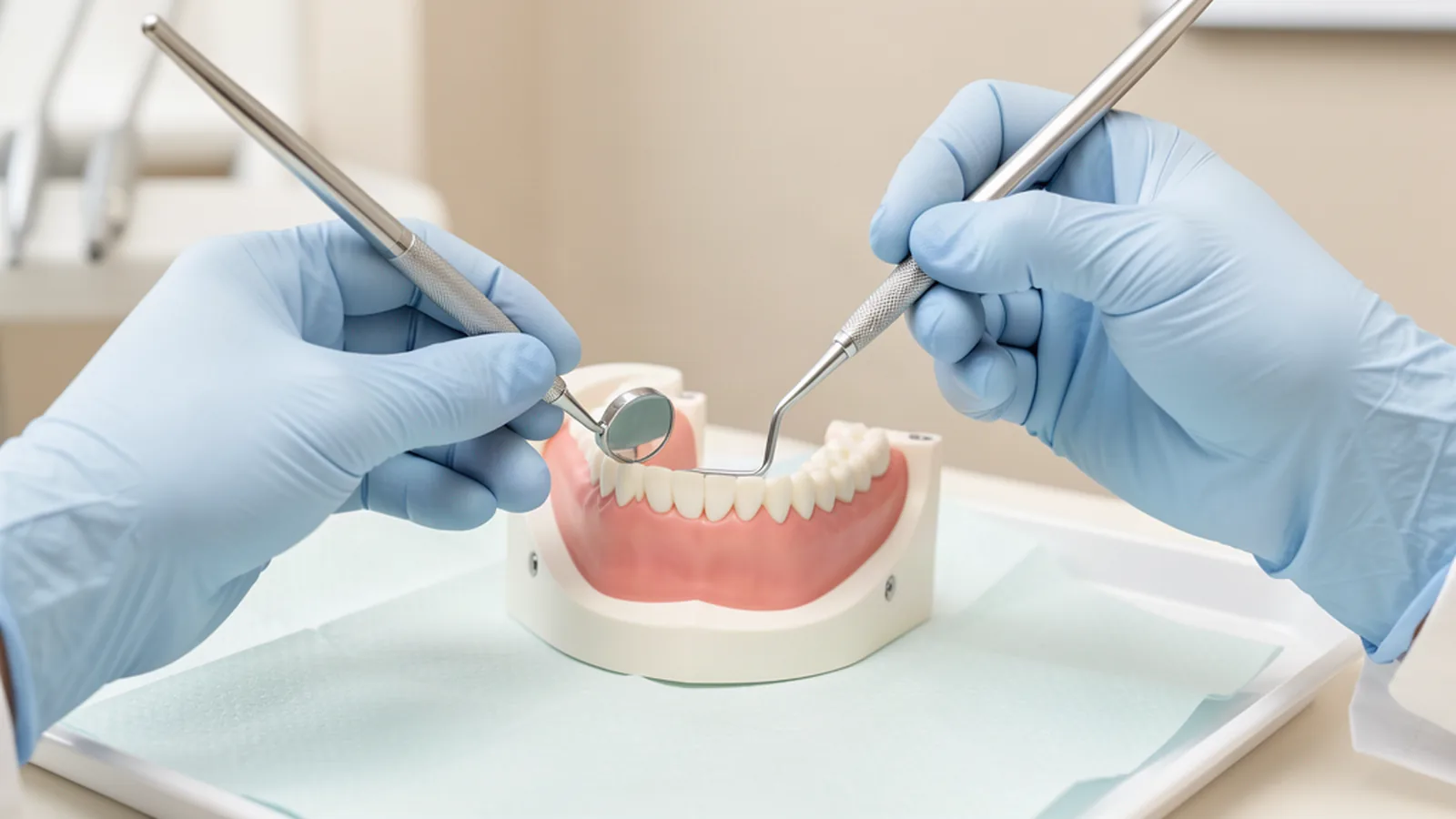
Match daily care to the restoration
Single crowns, fixed bridges, and removable implant dentures do not share one universal cleaning routine.
Warning signs that deserve a call
Contact the dental office if you notice:
- Bleeding or swelling that continues despite careful cleaning.
- Pus, a bad taste, or persistent odor from one area.
- Pain when biting or unexplained tenderness.
- A restoration that clicks, rocks, or feels different.
- A chipped tooth, fracture, or exposed screw-access material.
- Food trapping that is new or worsening.
- Difficulty getting cleaning tools beneath a full-arch bridge.
Implant problems are not always painful at first. Prompt assessment is preferable to waiting for the next routine visit.
Habits that influence long-term risk
Smoking and nicotine exposure can increase oral disease and healing risks. Poorly controlled diabetes may also affect periodontal and peri-implant health. Tell the dental team about medication changes and work with your physician on medical risk factors.
If you clench or grind, a protective appliance may be recommended. Do not use the implant restoration to open packages or chew ice and other very hard objects. Even strong ceramic and acrylic materials can chip or fracture under concentrated force.
Common maintenance questions
Do All-on-X teeth need to be removed by the dentist?
Some fixed restorations may be removed professionally when there is a clinical reason, but routine protocols differ by design and provider. Patients should not attempt to remove a fixed restoration themselves.
Is a water flosser enough?
It is useful for many patients, but it may not fully disrupt plaque on every surface. Your dental team may recommend combining it with bridge floss or small brushes.
How often should implant restorations be checked?
There is no single schedule for everyone. The interval should be based on individual risk and clinical findings. Patients with previous gum disease, complex full-arch work, or difficult hygiene access may need closer monitoring.
Protect the investment with a personalized routine
Dental implants and full-arch restorations are designed to restore function, but long-term success is a partnership. Good design, daily cleaning, risk-factor control, and professional maintenance all matter.
If you have implants, an implant denture, or All-on-X teeth in St. Joseph or the greater Kansas City area, St. Joseph Advanced Dental can evaluate your restoration and create a practical maintenance plan. Schedule a visit with board-certified prosthodontist Dr. Daniel Ben Yehuda, especially if your restoration feels different or is difficult to clean.

Leave a Reply